
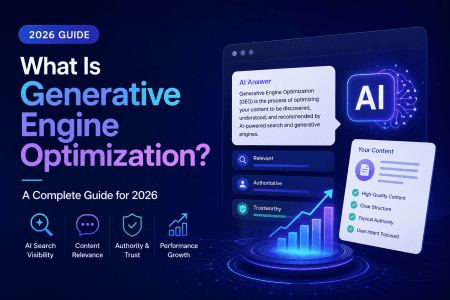
Generative Engine Optimization (GEO) is the practice of making your content easy for AI systems like ChatGPT, Perplexity, Gemini, and Claude to understand, trust, and cite in their answers. If you want Aimplyfy to show up where people are now asking questions, Generative Engine Optimization is the strategy that turns your content into an AI-visible asset instead of just a search ranking asset.
In 2026, search is no longer only about blue links. Users want direct answers, summaries, recommendations, and comparisons from AI tools. That means your content needs to be structured for both traditional search engines and generative engines. Aimplyfy is built for this shift, and this guide explains how GEO works, why it matters, and how to implement it.
Takeaway: GEO helps your brand become the source AI systems quote, summarize, and recommend.
What GEO Means in 2026
Generative Engine Optimization is the process of optimizing content so large language models and answer engines can use it confidently in generated responses. Unlike traditional SEO, which focuses on ranking web pages, GEO focuses on being referenced inside AI-generated answers.
This matters because users increasingly ask AI tools instead of typing keywords into Google. They want “best software for X,” “how to fix Y,” or “what is Z” and receive a synthesized answer instantly. If your content is clear, well-structured, and authoritative, AI systems are more likely to surface it.
GEO vs SEO
SEO is designed to improve visibility in search results. GEO is designed to improve visibility in generated answers. SEO gets you clicks from rankings; GEO gets you mentions, citations, and inclusion in AI responses.
That does not mean SEO is dead. It means SEO now feeds GEO. The same high-quality content can work for both, but only if it is written in a way that AI systems can parse quickly.
Why GEO matters now
AI search is changing how people discover brands, services, and answers. Instead of browsing ten pages, users may see one generated answer with a handful of cited sources. If your brand is absent from that answer, you may lose visibility even if you rank well in Google.
For Aimplyfy, this is the opportunity: help brands track and improve how often they appear in AI answers across major engines.
Takeaway: GEO is about becoming a trusted source inside AI answers, not just ranking in search results.
How AI Search Chooses Sources
AI systems do not “rank” in the same way Google does. They select and synthesize information from sources they consider relevant, credible, and easy to extract. That makes structure, clarity, and trust signals extremely important.
If a page is messy, vague, or overly promotional, AI systems may ignore it. If a page has direct answers, strong topical focus, schema markup, and supporting context, it becomes far more usable.
Clarity beats cleverness
AI models prefer content that states the answer plainly. A direct definition, a step-by-step process, or a simple comparison table is easier to cite than abstract marketing language.
That is why GEO content should be written in a plain, confident, and informative style. Avoid stuffing paragraphs with jargon. Make the answer easy to lift.
Authority signals matter
AI systems look for signals that suggest your content is reliable. These can include consistent branding, topical depth, helpful internal links, author identity, and supporting references.
For Aimplyfy, this means each blog post should reinforce expertise around AI visibility, SEO, schema, local discovery, and search automation. The more consistently you cover a topic cluster, the more trustworthy your site becomes.
Structure helps extraction
Well-organized pages are easier for AI to read and summarize. Use headings, short sections, bullet lists, definitions, and FAQs. These content patterns improve readability for humans and machine systems alike.
You should think of your article as a source file for answers, not just a web page. The better it is structured, the more likely it is to be quoted.
Takeaway: AI systems favor content that is clear, structured, and consistently authoritative.
Key GEO Signals
To optimize for GEO, your content should include the signals that generative engines can reliably interpret. These signals do not guarantee citations, but they improve your chances.
Topical Depth
Cover a topic fully instead of writing shallow, generic content. A strong GEO page should explain the concept, why it matters, how it works, how to implement it, and common mistakes.
If your page answers the main question and the follow-up questions in one place, it becomes a better source for AI. This is especially important for pillar pages like this one.
Schema and Metadata
Schema markup helps search engines understand the meaning of your page. While schema is not magic, it gives AI and search systems additional context about your content type, organization, author, and purpose.
Use clean titles, meta descriptions, and structured data that match the page intent. Avoid misleading title tags or vague descriptions.
Internal linking
Internal links show how your content topics are connected. For GEO, this matters because topic clusters signal expertise and create a clearer content graph.
A post about GEO should link to related posts like GEO vs SEO, AI visibility tracking, schema optimization, llms.txt, and local AI discovery. That helps both humans and machines understand your expertise area.
Brand consistency
AI systems benefit from consistency across your site. Use the same brand name, the same messaging themes, and a similar tone across key pages.
If Aimplyfy uses consistent terminology around AI visibility, local growth, and generative search, it becomes easier for AI systems to associate those ideas with your brand.
Takeaway: GEO performance improves when your site sends clear signals of depth, structure, and consistency.
How to Optimize for GEO
GEO is partly content strategy and partly technical optimization. You need both to increase your chances of appearing in generated answers.
Write answer-first content
Start sections with the answer, then expand. This makes it easy for AI systems to extract the most important line quickly. It also improves readability for busy human readers.
For example, define the term in the first sentence, then explain the context in the next few lines. This pattern works especially well for pillar posts and FAQs.
Use question-based headings
Many AI queries are phrased as questions. If your article uses headings that mirror those questions, it becomes more extractable and relevant.
Examples include:
- What is GEO?
- How does GEO work?
- Why does GEO matter?
- How do you optimize content for AI search?
This makes the page easier to match with user intent.
Include concise quotable lines
Each section should contain at least one sentence that can stand alone as a summary. These sentences are especially useful for GEO because AI systems often pull short, clear statements.
Examples:
- GEO turns content into AI-visible assets.
- AI search rewards clarity more than complexity.
- The best GEO content answers the question before explaining it.
Support with examples
Examples help AI systems understand how the concept works in practice. They also improve human trust and retention.
For Aimplyfy, examples can include a SaaS brand improving its AI visibility, a local business optimizing location pages, or a content team building an answer-ready blog structure.
Takeaway: The best GEO content answers questions directly, uses clear headings, and includes short quotable lines.
Why Aimplyfy Needs GEO
Aimplyfy sits at the center of a major shift in search behavior. Brands now need to know not just whether they rank, but whether they are mentioned in AI answers.
Track visibility across AI platforms
Businesses want to know if they appear in ChatGPT, Perplexity, Gemini, and Claude. GEO makes that visibility measurable and improvable.
That is valuable because visibility in AI search can influence awareness, trust, and lead generation before a user ever reaches a website.
Improve local and brand discovery
GEO is especially important for local and multi-location brands. AI tools often answer location-based questions with a limited set of sources, so the right content can shape recommendations.
If a business wants to be discoverable in AI-assisted local search, it needs pages that are structured, specific, and locally relevant.
Build a future-proof content engine
GEO is not a temporary trend. It reflects a deeper shift from keyword matching to answer generation. Brands that adapt early will have an advantage.
Aimplyfy can help businesses create content that works in both search and AI systems, which is exactly where discoverability is headed.
Takeaway: Aimplyfy helps brands win visibility in the new answer-driven search landscape.
Common GEO Mistakes
Many teams fail at GEO because they still write content like it is 2018. AI systems have different expectations, and old tactics often fall flat.
Overstuffing keywords
Repeating keywords too often does not help. It can make the content harder to read and less credible. Focus on natural language and clear intent instead.
Writing vague intros
If the first paragraph is generic, AI systems may not quickly understand the article’s purpose. Your intro should explain the topic and relevance immediately.
Ignoring structure
Large blocks of text are difficult to scan. Use headings, bullets, short paragraphs, and direct answers to improve extractability.
Skipping topical coverage
A single post is not enough to establish authority. GEO works best when you build a connected set of articles around the same theme.
Takeaway: GEO fails when content is generic, poorly structured, or too thin to trust.
FAQ
What is Generative Engine Optimization?
Generative Engine Optimization is the practice of optimizing content so AI systems can understand it, summarize it, and cite it in generated answers.
Is GEO different from SEO?
Yes. SEO focuses on search rankings, while GEO focuses on visibility inside AI-generated responses.
How do I start GEO for my website?
Start by writing answer-first content, using clear headings, adding schema, building topic clusters, and publishing authoritative blog posts around your niche.
Conclusion
Generative Engine Optimization is now a core part of digital visibility. If your content is not built for AI systems, you risk becoming invisible in the places where users increasingly get answers. For Aimplyfy, GEO is not just a tactic — it is the foundation of the product category.
If you want your brand to be found, cited, and recommended by AI, your content must be structured for the answer era. GEO gives you that edge.
Final takeaway: The brands that win in 2026 will be the ones AI can understand, trust, and cite quickly.