
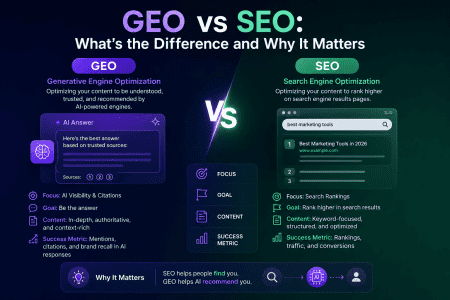
If you are trying to grow your brand’s online visibility in 2026, you need to understand the difference between GEO vs SEO. Search Engine Optimisation gets your pages ranking in Google. Generative Engine Optimization gets your brand cited inside AI answers on ChatGPT, Perplexity, Gemini, and Claude. These are two different games with two different rules — and Aimplyfy is built to help you win both.
The shift is simple: users used to search and click. Now they ask and read a generated answer. If your brand only plays the SEO game, you are invisible in half the places your audience is looking.
Takeaway: GEO and SEO are not competitors — they are two layers of the same modern visibility strategy.
What Is SEO?
Search Engine Optimization is the practice of improving your website so it ranks higher in search engine results pages like Google and Bing. It has been the dominant digital marketing discipline for over two decades.
SEO works by satisfying the ranking signals of search engine algorithms, which weigh factors like keyword relevance, page authority, backlinks, technical performance, and content quality.
How SEO drives visibility
When someone searches “best AI marketing tool,” SEO determines which pages show up in the top results. A well-optimized page with strong backlinks, a clear title, and relevant content has a better chance of ranking near the top.
SEO is largely about getting your page in front of users so they can click through to your website.
What SEO focuses on
- Keyword research and targeting
- On-page optimization — titles, headings, meta descriptions
- Backlink building and domain authority
- Technical performance — site speed, crawlability, mobile responsiveness
- Content depth and relevance
What SEO does well
SEO is excellent for driving consistent organic traffic over time. A strong SEO foundation builds compounding returns — a well-ranked post from two years ago can still drive leads today.
Takeaway: SEO gets your pages in front of users who are actively searching in Google.
What Is GEO?
Generative Engine Optimization is the practice of structuring your content so that AI systems can understand it, extract meaning from it, and confidently cite it in generated responses.
GEO emerged as AI-powered answer engines like ChatGPT, Perplexity, Claude, and Gemini became primary destinations for information queries. These systems do not simply rank pages — they synthesize answers from sources they consider credible, clear, and relevant.
How GEO drives visibility
When someone asks Perplexity “what is the best tool for tracking AI brand visibility,” GEO determines whether Aimplyfy gets mentioned in the answer. Instead of a click on a list, the user receives a synthesized recommendation.
If your content is well-structured, factual, and topically authoritative, AI systems are more likely to reference your brand in their output.
What GEO focuses on
- Clear, answer-first content structure
- Topical depth and authority signaling
- Schema markup and metadata
- Quotable, standalone sentences in each section
- FAQ sections that mirror user queries
- Consistent brand presence across indexed content
What GEO does well
GEO increases brand mentions inside AI-generated answers, which shapes discovery at the top of the decision-making funnel. A user may encounter your brand name in a Perplexity answer before they ever visit your website.
Takeaway: GEO gets your brand mentioned inside AI answers where users increasingly look first.
GEO vs SEO: The Core Differences
Both strategies aim to improve visibility, but they work in fundamentally different ways. Understanding the differences helps you prioritize your content investment correctly.
The destination is different
SEO targets Google’s ranking algorithm. GEO targets the language models and retrieval systems behind AI answer engines. These systems use different signals, different evaluation logic, and different output formats.
The output is different
SEO success looks like a high-ranking page in search results. GEO success looks like a citation, mention, or recommendation inside a generated answer. You may not always get a click from GEO — but you get awareness, trust, and top-of-funnel influence.
The signals are different
| Signal | SEO | GEO |
|---|---|---|
| Backlinks | High importance | Low direct impact |
| Schema markup | Helpful | Very important |
| Keyword density | Moderate importance | Low importance |
| Content clarity | Important | Critical |
| Topical depth | Important | Very important |
| Answer-first structure | Optional | Essential |
| FAQ sections | Helpful | Very important |
| Brand consistency | Indirect benefit | Direct benefit |
The timeline is different
SEO typically takes weeks or months to show results. GEO can influence AI answers faster, especially if the content is already indexed, well-structured, and from a trusted domain.
Takeaway: SEO and GEO use different signals, target different systems, and deliver different types of visibility.
Why Both Matter in 2026
The mistake most brands make is treating GEO and SEO as either/or choices. In 2026, you need both — and the good news is that they support each other more than they conflict.
GEO builds on SEO
A page that ranks well in Google is more likely to be indexed and trusted by AI systems. Strong backlinks, good domain authority, and fast loading still matter because they signal credibility that AI systems recognize.
That means your SEO investment is not wasted — it is the foundation that GEO builds on.
SEO benefits from GEO content
When you write answer-first, structured, topically deep content for GEO, that content also tends to rank well in Google. Clear headings, FAQ sections, and schema markup all improve traditional search performance too.
GEO-optimized content is simply better content. It communicates more clearly, answers intent more directly, and satisfies both human readers and machine systems.
The combined strategy
The strongest visibility strategy in 2026 is to:
- Build strong topical authority through consistent blogging
- Use clear, structured, answer-first writing
- Add schema markup on key pages
- Publish FAQs on every major topic
- Track brand mentions in both search and AI enginesTakeaway: Brands that invest in both GEO and SEO will compound their visibility across every channel where users are searching for answers.
How Aimplyfy Covers Both
Most SEO tools only tell you where you rank on Google. Aimplyfy tracks where your brand appears across Google, ChatGPT, Perplexity, Gemini, and Claude simultaneously — giving you the full picture of your visibility.
Real-time AI visibility tracking
Aimplyfy monitors whether your brand is being mentioned in AI-generated answers and how often. That is the core GEO metric that no traditional SEO platform measures.
Local growth with SEO and GEO
For businesses with physical locations, Aimplyfy also optimizes local presence — combining local SEO foundations with GEO strategies that get your brand named in AI responses for location-based queries.
Content and schema optimization
Aimplyfy helps you identify what content gaps and schema improvements would increase your AI citation rate — giving you a clear action plan instead of just analytics.
Takeaway: Aimplyfy is the only platform that lets you track and improve your brand visibility in both traditional search and AI-generated answers.
Common Mistakes When Choosing Between GEO and SEO
Many brands either ignore GEO entirely or abandon SEO in favour of it. Both mistakes cost visibility.
Ignoring GEO
If you are only running an SEO strategy in 2026, you are invisible in the places where millions of users now get their answers. AI search is not a niche use case — it is mainstream.
Abandoning SEO for GEO
SEO drives traffic, backlinks, and domain authority — all of which feed your GEO performance. Dropping SEO to “do GEO” would undercut the foundation your AI visibility depends on.
Writing for one and not the other
Content written purely for keyword rankings often lacks the structure and clarity that GEO requires. Content written purely for AI citation sometimes lacks the depth and keyword targeting that SEO needs. Write for both from the start.
Takeaway: The biggest GEO and SEO mistake is treating them as competitors instead of complements.
FAQ
Is GEO replacing SEO?
No. GEO and SEO serve different channels. SEO covers Google and Bing; GEO covers AI answer engines. You need both in 2026 to achieve full-spectrum brand visibility.
Which is more important, GEO or SEO?
Neither is more important in isolation. SEO drives sustainable traffic from search engines while GEO drives brand awareness inside AI answers. Together they create a compounding visibility advantage.
How does Aimplyfy help with GEO vs SEO?
Aimplyfy tracks your brand’s visibility in both traditional search results and AI-generated answers, helping you measure and improve your presence across Google, ChatGPT, Perplexity, Gemini, and Claude from a single dashboard.
Conclusion
GEO and SEO are not rivals, they are the two pillars of modern search visibility. SEO keeps you discoverable on Google. GEO keeps you present inside the AI answers your audience is now trusting first.
The brands that win in 2026 will not have to choose between them. They will build a content strategy that feeds both, using authoritative, structured, answer-ready content that performs across every channel. Aimplyfy is the platform built to track, measure, and improve that combined visibility.
Final takeaway: In the age of AI search, winning brands are not just ranking — they are being cited, recommended, and named.