
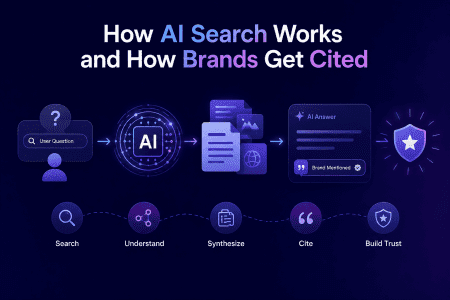
If your brand is not showing up in AI-generated answers, you are missing the fastest-growing discovery channel in 2026. Understanding how AI search works is the first step to fixing that. Platforms like Perplexity, ChatGPT, Gemini, and Claude do not just rank pages, they read, synthesize, and cite sources they trust. Aimplyfy helps brands track exactly where they appear across all of these engines, so you can measure and improve your AI visibility before your competitors do.
Takeaway: AI search does not rank your page, it decides whether your brand deserves to be cited in the answer.
How AI Search Engines Actually Work
Traditional search engines like Google use an index and a ranking algorithm. AI search engines add a generation layer on top. They retrieve relevant content, synthesize it into a natural answer, and surface sources that informed that answer.
Retrieve, read, generate
Most AI answer engines follow a three-step process:
- Retrieve — The system pulls relevant content from its training data or a live web index
- Read — It extracts the most useful information from those sources
- Generate — It writes a natural-language answer and attributes it to cited sources
If your content is not indexed, unclear, or too thin, it gets skipped at step two. If it is well-structured, credible, and directly relevant, it gets synthesized into the answer.
Training data vs live search
Some AI systems like ChatGPT answer from training data, which means content published before their training cutoff influences their responses. Others like Perplexity use live web retrieval, meaning freshly published, well-indexed content can be cited almost immediately.
For Aimplyfy, this means publishing regularly matters. Fresh, authoritative content has a better chance of appearing in live AI search results.
Takeaway: AI systems pick sources based on clarity, credibility, and structure, not just keyword relevance.
What Makes a Brand Get Cited
AI systems do not randomly pick sources. They prefer content that is easy to extract, clearly authoritative, and topically consistent. Here is what drives citation likelihood.
Clear, direct answers
AI systems favor content that answers the question in the first sentence of each section. If a user asks “what is GEO,” a page that defines it immediately is more useful than one that spends three paragraphs building up to the definition.
Write answer-first. State the point, then explain it.
Topical authority
A brand that consistently publishes content around one topic cluster becomes more trustworthy in AI systems over time. If Aimplyfy publishes ten well-structured articles about AI visibility, GEO, and brand tracking, those signals accumulate.
One strong post helps. A connected content cluster is significantly more powerful.
Schema and structured data
Schema markup tells AI systems and search engines what your content means in context. It signals whether a page is about a product, a service, a how-to guide, or an organization.
Pages with schema are easier for AI systems to understand and therefore easier to cite.
Consistent brand identity
AI systems associate certain concepts with certain brands when that brand is consistently referenced across trusted sources. If Aimplyfy is mentioned across blog posts, case studies, and external coverage in the context of AI visibility tracking, those associations strengthen.
Your brand name, product name, and core messaging should be consistent across all indexed content.
Takeaway: Brands get cited when their content is clear, deep, consistent, and structured for machine extraction.
The Role of Content Structure in AI Citation
Structure is the single most controllable factor in GEO. You cannot force an AI to cite you, but you can make your content significantly easier to cite.
Use headings that mirror questions
AI queries are usually conversational. If your H2 headings match the kinds of questions users ask, your page becomes more extractable.
Examples:
- How does AI search work?
- What makes brands appear in AI answers?
- Why is structured content better for GEO?
Write quotable one-liners
Every section should include at least one sentence that stands alone as a complete idea. These are the sentences AI systems are most likely to extract and cite.
Short, confident, factual statements work best. Avoid hedging language like “it could be argued” or “some experts believe.”
Include FAQs
FAQ sections directly match how users query AI tools. A well-written FAQ tells AI systems: here is a question, here is the answer — extract this.
Every major blog post should end with three to five FAQs that address follow-up queries users are likely to ask.
Takeaway: Structured content with direct answers, question-based headings, and FAQs is the content AI systems find easiest to cite.
How Aimplyfy Tracks AI Citation
Most brands have no idea whether they are being cited in AI answers. They invest in SEO, publish content, and assume visibility, but they never actually check what ChatGPT or Perplexity says about them.
Aimplyfy solves this by monitoring your brand across every major AI engine and tracking how often, where, and in what context your brand appears in generated answers.
That means you get real data on your AI visibility, not guesses. You can see which content is getting cited, which queries surface your brand, and what competitors are being mentioned instead of you.
Takeaway: Aimplyfy turns AI citation from a mystery into a measurable, improvable metric.
FAQ
How do AI search engines decide which brands to cite?
AI search engines cite brands whose content is clearly structured, topically authoritative, and consistently indexed. Schema markup, answer-first writing, and topical depth all increase citation likelihood.
Can any brand appear in AI search answers?
Yes. Any brand with well-structured, indexed, and authoritative content can appear in AI-generated answers. The key is consistent publishing and GEO optimization.
How does Aimplyfy help brands get cited in AI search?
Aimplyfy tracks where your brand appears across ChatGPT, Perplexity, Gemini, and Claude, identifies gaps in your AI visibility, and provides insights to help you optimize content for higher citation rates.
Conclusion
AI search is not the future — it is the present. Brands that understand how these systems work and optimize their content accordingly will be cited, recommended, and trusted in the places where users now get answers first.
The formula is not complicated: clear structure, topical authority, consistent publishing, and schema support. Aimplyfy makes sure you can see exactly where your brand stands across every AI engine — and exactly what to do next.
Final takeaway: The brands AI cites most are not the biggest, they are the clearest, the most structured, and the most consistent.