
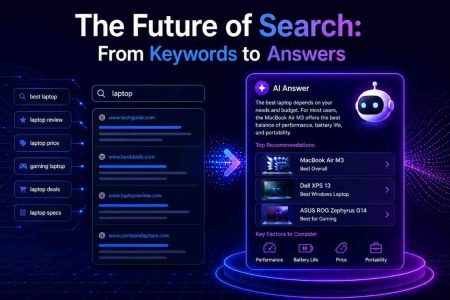
The Future of Search: From Keywords to Answers
Search used to be simple. People typed a keyword into Google, clicked a result, and moved on. That world is fading fast. In 2026, search is shifting from keywords to answers, and that changes everything about how brands get discovered online.
Instead of waiting for users to browse ten blue links, search engines and AI assistants now try to give the answer immediately. Whether it is Google AI Overviews, ChatGPT, Perplexity, Gemini, or Claude, the user experience is becoming more conversational, more direct, and more answer-driven.
That means the old question was “How do I rank for this keyword?” The new question is “How do I become the answer?” That is the shift Aimplyfy was built around — helping brands understand how visible they are in this new answer-first world.
Takeaway: Search is no longer just about ranking pages; it is about being included in the answer.
Why Search Is Changing
The way people search has changed because the way people ask questions has changed. Users are no longer typing short, robotic keyword phrases all the time. They are asking full questions, using natural language, and expecting immediate, useful responses.
Search engines have responded by becoming more semantic and more conversational. They are trying to understand intent, context, and meaning rather than just matching exact words.
People want answers faster
Nobody wants to open five tabs just to find a simple answer. They want clarity right away. That is why answer engines are growing so quickly.
When someone asks a question, they want the result to feel like a quick conversation, not a research project.
Keywords are still there, but they are not enough
Keywords still matter because they help search systems understand the topic. But keyword matching alone is no longer the full game. Search engines now care about whether your content actually solves the user’s problem.
That means a page can target the right keyword and still fail if it does not answer the question well.
Takeaway: Search is moving away from exact keyword matching and toward real understanding of intent.
From Ranking to Being Cited
In the old model, success meant ranking near the top of Google. In the new model, success also means being cited, summarized, or mentioned inside AI-generated answers.
That is a huge change. It means visibility is no longer only about page position. It is also about whether your content is trusted enough to be used as part of the answer itself.
Citations are the new visibility layer
When an AI system references your content, it is not just showing a link. It is saying your content helped shape the answer. That creates brand exposure even when the user never clicks through immediately.
For many brands, that is the new front door of discovery.
Being visible in the answer matters more than ever
A user may not remember which search result they clicked, but they will remember which brand was mentioned in the answer. That is why answer visibility is becoming such an important metric.
Aimplyfy exists in this space because brands now need to know more than just where they rank. They need to know whether they are appearing in the answer layer at all.
Takeaway: The future of search is not just about ranking — it is about being part of the response.
What Content Needs Now
To win in answer-first search, content needs to do more than repeat a keyword. It needs to be useful, structured, and easy to extract.
That means the best content in 2026 is the content that answers clearly and proves its value quickly.
Content must be clear
If your content is vague, search systems are less likely to use it. Clear content gets to the point, explains the topic properly, and avoids unnecessary fluff.
The more direct your writing is, the easier it is for both humans and machines to trust it.
Content must be structured
Headings, short paragraphs, lists, and FAQs make content easier to scan. They also make it easier for AI systems to understand where one idea ends and the next begins.
This is not just a formatting preference. It is part of how content becomes machine-readable.
Content must be helpful
Search engines increasingly reward content that genuinely helps people. This means answering the question fully, providing examples, and making the next step obvious.
A page that is useful will always outperform a page that is just optimized.
Takeaway: Content that wins in the future will be clear, well-structured, and genuinely useful.
What Brands Must Do
Brands that want to stay visible need to adapt their content strategy now. That means rethinking how they create, structure, and measure content.
The old model was centered around one keyword and one ranking goal. The new model is centered around topical authority, answer readiness, and visibility across multiple search surfaces.
Build topic clusters
One isolated article is not enough anymore. Brands need connected content around the same theme. This helps search systems understand expertise and makes the site more trustworthy overall.
If a brand wants to be known for AI visibility, for example, it should publish content about GEO, AI search, schema, brand tracking, local discovery, and answer optimization.
Optimize for both search and AI
The best content in 2026 works in both worlds. It should be strong enough to rank in Google and clear enough to be cited by AI systems.
That is why Aimplyfy’s positioning matters so much: brands do not just need SEO anymore. They need search visibility across Google and AI answers together.
Measure visibility differently
Clicks alone are not enough to measure success anymore. Brands need to know if they are mentioned, cited, and surfaced in answer engines.
That is where visibility tracking becomes powerful. It gives brands a much more complete picture of how discoverable they really are.
Takeaway: Future-proof brands will measure visibility across rankings, citations, and AI mentions.
Why Aimplyfy Matters
This shift from keywords to answers is exactly why Aimplyfy exists.
Most brands still think visibility means ranking for a few keywords in Google. But in the real world, users are getting answers from AI tools before they ever click a link. If your brand is not present in those answers, you are missing the new discovery layer.
Aimplyfy helps brands track where they appear across Google and major AI search engines, so they can see where they are strong and where they are invisible. That makes the future of search measurable instead of mysterious.
It also helps brands move beyond guesswork. Instead of wondering whether your content strategy is working, you can actually see whether your brand is being surfaced in the places that matter.
Takeaway: Aimplyfy helps brands adapt to a search world where visibility happens inside answers, not just results.
What Happens Next
The shift will not happen overnight, but it is already happening. Search will continue becoming more conversational, more personalized, and more answer-driven. That means brands that adapt early will have a major advantage.
In practical terms, that means:
- Better content structure.
- Stronger topical authority.
- More helpful answers.
- More focus on AI visibility.
- Less obsession with isolated keywords.
The brands that win will not be the ones chasing the most keywords. They will be the ones building the clearest, most useful, most answer-ready content.
Takeaway: The future belongs to brands that can answer better, not just rank higher.
FAQ
Is keyword SEO dead?
No. Keywords still matter, but they are now just one part of a much bigger search strategy that includes intent, structure, and answer visibility.
What is replacing keyword-first SEO?
Answer-first content is becoming the new standard. Search systems now want to surface the most useful answer, not just the page with the exact keyword match.
How does Aimplyfy fit into the future of search?
Aimplyfy helps brands track visibility across Google and AI search engines so they can see whether they are ranking, being cited, and actually showing up in answers.
Conclusion
The future of search is not about typing a keyword and hoping to rank. It is about asking a question and getting the best answer possible. That changes how content is created, how brands are discovered, and how visibility should be measured.
For brands like Aimplyfy, this is the moment to build around the answer economy. The companies that understand this shift early will not just rank better. They will be cited more, remembered more, and discovered more often.
Final takeaway: Search is moving from keywords to answers, and the brands that adapt first will own the next era of visibility.